First Category
Champion and Creativity Award
Harrow International School Hong Kong
Alana Kwan; Eason Ying; Jacko Chan; Cyrus Tsui
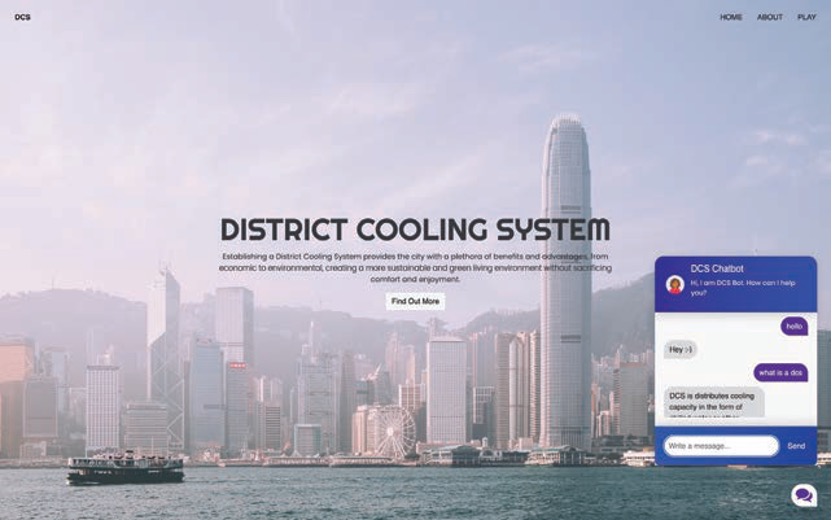
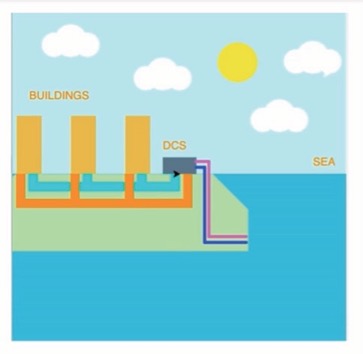
Our program is a website consisting of a comprehensive information page, an interactive quiz and an intelligent
chatbot to effectively achieve our goal of promoting widespread understanding of District Cooling Systems (DCS).
Visitors to our website can find technical information about what a DCS is, how it works, its advantages and why
districts might want to use it all within the “about” pages.
Our quiz page then presents users with questions that are not profoundly puzzling but still challenging, that
not only peak users’ interest to learn more about DCSs, but also significantly accelerates their rate of
understanding. The logic of the quiz is coded entirely in Python.
In addition, each question has visual aids, for instance animated graphs of relevant data to make the quiz page
more lively and engaging.
At the corner of the homepage is a welcoming button leading to a chatbot. The Chatbot is also written entirely
in Python on the back-end. Using Artificial Intelligence and Machine Learning, our chatbot is able to answer
frequently asked questions, and hopefully resolve most users’ questions about DCSs
1st Runner-up
St. Louis School
Li Cheuk Yin; Lee Ho Nam; Lam Ho Hei Keynes

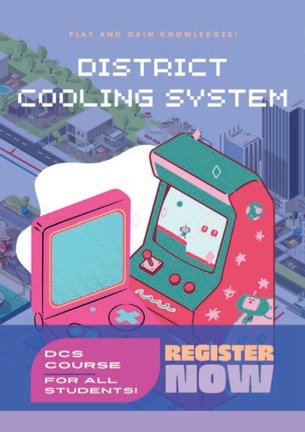
Our plan was to use methods such as classroom teaching to increase public awareness of District Cooling Systems
(DCS) and its functional principles. By educating the public on DCS and the importance of its widespread usage,
we hope that DCS will be more widely acknowledged and supported.
During these classes, both secondary and primary school students can learn via playing our “DCSGAME”. And
because of the fun of playing a game, students will stay engaged. And the game is simple enough that it will not
take long to complete, at the same time giving them enough information to understand DCS and its inner workings.
Students are our future, so this plan is specifically tailored to educate them, and let them understand the
severity of global warming, thus building a less carbon-intensive world.
2nd Runner-up
Valtorta College
Feng Chi Yeung; Huang Siming; Chen Yu Kuen; Zhuang Shikun
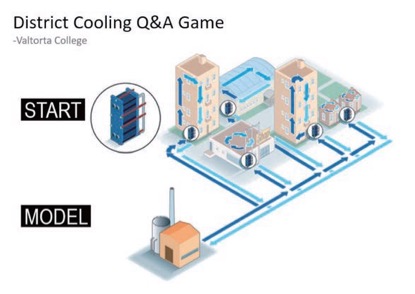
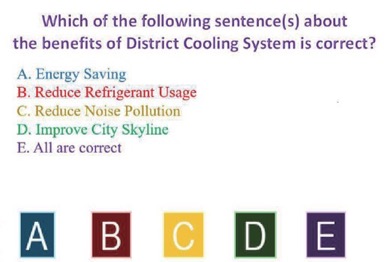
District Cooling Q&A Game is a question-answer game with graphic user interface (GUI). Firstly, players can
click the model button to read the structure and model of District Cooling System (DCS) to familiarize
themselves with some basic information of District Cooling System.
Then, players can click the Start button to start the game. Each question has a number of options and all of
these questions are related to District Cooling System.
After answering a question, an elaboration part is provided. It shows and explains the answer to expand the
player’s knowledge of DCS. When the 12 questions are answered, the total score will be displayed to motivate the
player.
Through the Q&A game, players can understand and even be interested in the District Cooling System, as well as
increasing the public’s awareness of the District Cooling System. This will allow the public realize there are
sustainable ways to keep cool during the summer.
Second Category
Champion and Creativity Award
St. Paul's Secondary School
Ou Yang Bing, Icy; Kwok Wing Yiu, Natalie; Luk Wing Tung, Jobe; Lee Wing Yin, Nicole
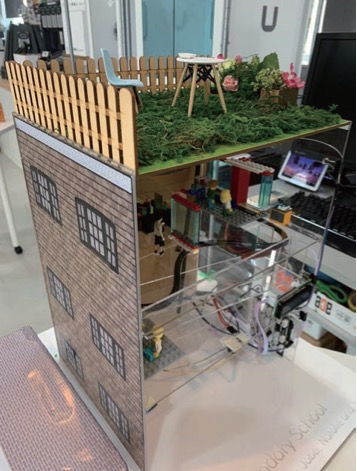
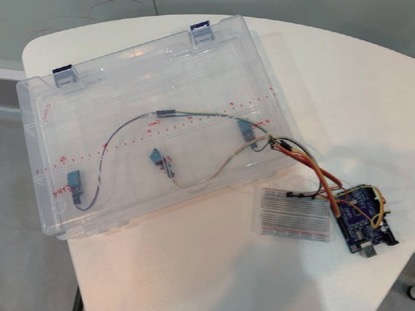
This product is aimed to improve the current cooling system by introducing a sensor system connected with an
Arduino to detect water leakage by using sewage after treatment from the building, and to carry out an
investigation with data collected to support our hypothesis – the relationship between temperature and humidity
to the underground (within sensors) and above ground.
Our building leverages district cooling system for cooling power and utilises treated effluent as cooling medium
in chilled water circuit. Temperature and humidity sensors are used within the building and underground to check
for water leakage of the water pipe, as well as controlling the speed of the water pump to determine the cooling
effect. Water leakage sensors are used to check and prevent further leakage in the water pipe. It will stop the
water pump and alert the technicians when water leakage is detected. Arduino Board connects sensors to the
monitor to show the real-time conditions of the water pipe. The data collected from Arduino is sent to MS Excel
for plotting graphs and continuous monitoring. With the sensor monitor, and graph/ alarm (buzzer) produced,
technicians can easily notice an abnormal performance and carry out follow up actions to maintain the system.
1st Runner-up
Nord Anglia International School Hong Kong
Ansen Yan
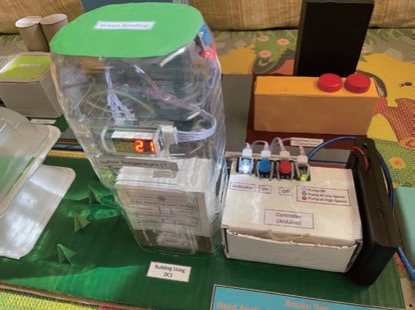
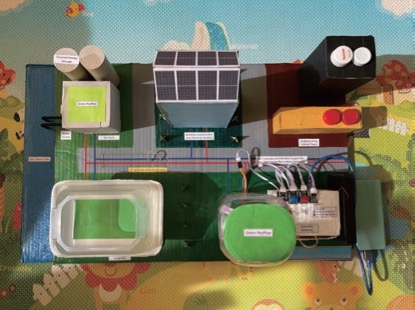
My product is a city model of the District Cooling System (DCS) made using recycled materials. Apart from
showing the DCS network, a core feature of my model is a simulation of controlling the cold-water pump on a
building sub-station via the collected data from indoor temperature and humidity.
The motor speed indicator can be in three states: off, green or red. If the motor speed indicator is off, this
signifies that the motor is turned off, either by pressing the “Off” button or if the current heat index is
under 19°C. If the motor speed indicator is green, this signifies that the motor is in low-speed operation when
the current heat index is between 19 °C and 22 °C. This is the case when the air ventilation has less need for
cold water. Lastly, if the motor speed indicator is red, this signifies that the motor is under high-speed
operation when the current heat index is above 22 °C. This is the case when the air ventilation has more need
for cold water.
Finally, another highlight of my product is that, in fitting with environmental protection, the whole model is
mainly made from recycled materials, such as used cardboards, papers, plastic bottles, straws, bottle caps, etc.
2nd Runner-up
SKH Bishop Baker Secondary School
Lau Zi Juan Cecil; Hong Kris; Tse Man Hei
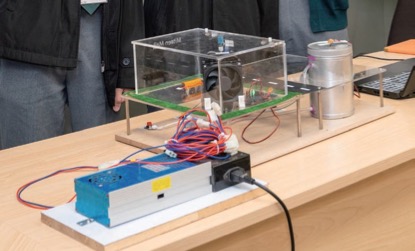
Our model creates a self-regulating cooling system that maximises the efficiency of the water cooling system and
reduces costs.
In terms of hardware, we use the DHT11 for temperature detection. Therefore, we have set a temperature standard
in the internal programming. We use a heating resistor to simulate a heating source. If the temperature is
higher than the standard, the cooling system will be kept running; if not, it will be interrupted. This allows
both internal cooling and energy consumption to be accounted for.
In terms of software, we can obtain a prediction of customer flow for all periods by data analysis so as to know
when to run the system before peak periods and when to close it before low periods. In addition, the system can
be kept running when the temperature is above standard and intermittently run when the temperature is below
standard.